
In 2026, Gearbox's Borderlands 4 has already become a notable case study in how modern looter shooters can embrace curiosity-driven exploration. When the game launched on September 12, 2025—moved up from its original September 23 date—it arrived with a clear promise: the planet Kairos would let players chase almost anything they could see on the horizon. That promise drew direct inspiration from The Elder Scrolls 5: Skyrim, and the connection became unmistakable after comments from Gearbox CEO Randy Pitchford during the pre-launch reveal cycle.
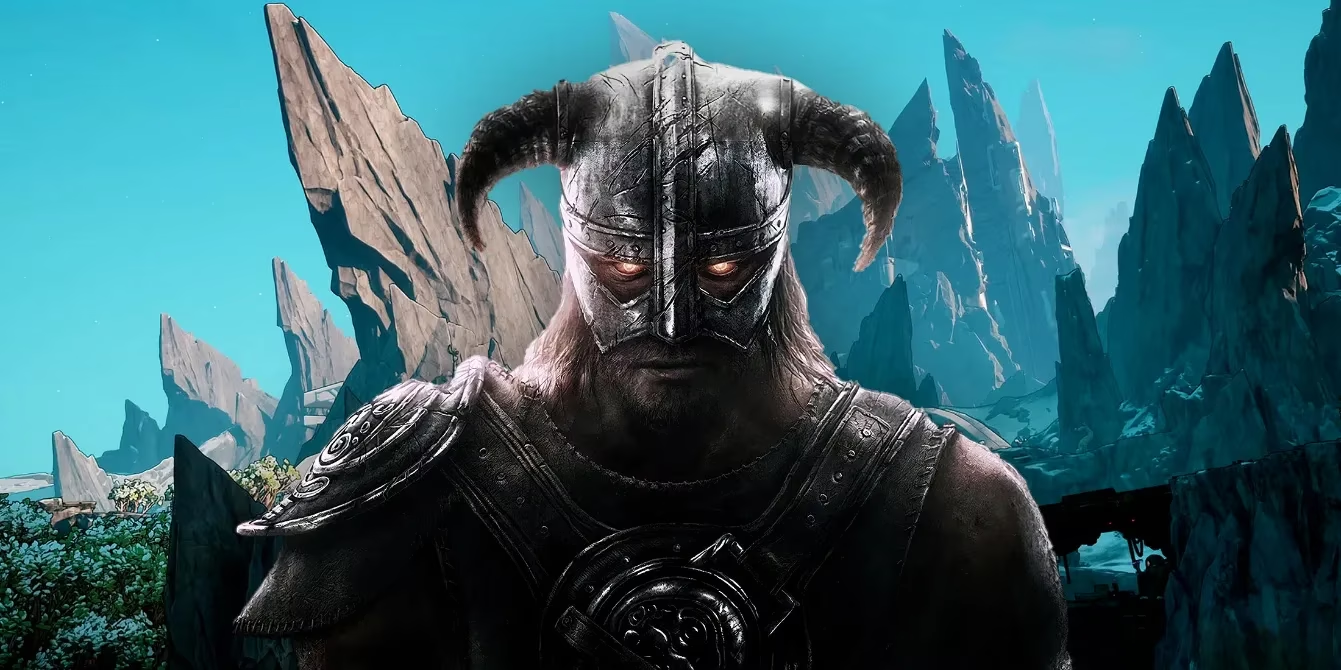
Skyrim's lasting influence is hard to overstate. When Bethesda released the game in November 2011, it helped define a generation of open-world design around a simple but powerful idea: if players can see it, they can reach it. Todd Howard famously framed that philosophy during Skyrim's marketing phase with the statement, "That mountain is not just a backdrop. You can walk all the way to the top of that mountain." In an era when many games used distant geometry as decoration, Skyrim treated the horizon as an invitation.
Gearbox appears to have borrowed that exact playbook for Kairos. Although Borderlands 4 is not technically a fully open-world game, its developers built the planet to feel wide, layered, and unusually accessible. There may still be loading screens in certain transitions, but the overall structure is seamless enough that Gearbox has repeatedly described exploration as natural rather than checkpoint-driven. During a PAX East panel on May 9, 2025, Pitchford summed up the approach in language that deliberately echoed the spirit of Skyrim: "You see something anywhere on the screen, a mile away, up in the sky, you will be able to get there."
That single line reveals a lot about how Borderlands 4 was designed to guide its players. Instead of relying heavily on a clutter of map markers, Gearbox leaned into curiosity as the primary motivation. A glowing landmark, a distant structure, an unusual rock formation, or even a floating object high above the surface can become a beacon. Players are encouraged to pick a direction and investigate, and the world reportedly rewards that curiosity with loot, side encounters, and environmental storytelling.
🔹 Key takeaways from Gearbox's exploration philosophy:
-
Kairos offers seamless exploration with very few loading screens.
-
Distant points of interest are designed to be reachable, not purely visual.
-
Discovery follows natural player curiosity rather than constant map icons.
-
The philosophy echoes Skyrim's famous "see that mountain, climb it" promise.
The implications go beyond a simple technical feature. Skyrim's most memorable strength was not just size, but the feeling that the world had been assembled for wandering. In the years since, many open-world games have chosen to copy Skyrim's scale while losing that sense of invitation, burying players under objective lists and fast-travel prompts. By explicitly invoking Skyrim's most famous exploration trick, Gearbox signaled that Borderlands 4 wanted to recapture that older, more organic relationship between player and landscape.
Borderlands 4's version of this idea also fits neatly with the series' identity. Past Borderlands games offered large maps, but they often felt segmented by area transitions and objective-heavy questing. Kairos, by contrast, was built to feel more connected. The planet includes varied regions, but the team designed sightlines so that a player standing in one zone can spot something in another and then actually travel toward it. That creates a persistent sense of place, even when the game does break for a loading screen.
The move also reflects a broader shift in game design in the mid-2020s. After years of ever-expanding maps, many developers began talking less about square mileage and more about density, readability, and player agency. Gearbox's approach with Borderlands 4 sits comfortably within that conversation. The goal was not to make the biggest Borderlands map ever, but to make the most curiosity-driven one.
Of course, living up to a Skyrim-style promise is difficult. A mountain in Skyrim remains one of the genre's most enduring metaphors because the climb itself mattered. In Borderlands 4, that moment arrives when a player spots a strange monolith across a desert, jumps into a vehicle, and discovers that the landmark is not scenery but an actual destination with its own story. That loop—spot, travel, arrive, be rewarded—is exactly what the team described before launch.
Now, in 2026, the results are part of the game's identity. Community discussions frequently mention the joy of wandering off a quest path and finding something unexpected, a sign that the Skyrim-inspired approach landed with players. While Borderlands 4 still delivers the guns, loot, and humor the franchise is known for, its exploration design has become one of its most discussed features.
In the end, borrowing from Skyrim was a smart move. It allowed Gearbox to communicate a complex design philosophy through a familiar reference point. More importantly, it gave players a clear expectation: in Borderlands 4, the horizon is not just decoration. It is an offer.
Comments