
In the ever-shifting landscape of looter-shooters, few franchises have clung to their foundational identity as stubbornly as Borderlands. For over a decade, the series delivered a reliable cocktail of vibrant cel-shaded visuals, billions of procedurally generated guns, and worlds stitched together from discrete, loading-screen-separated maps. Even as competitors pivoted toward sprawling open worlds and frictionless exploration, Gearbox’s creation hummed along on its familiar rhythm — until now. As 2026 unfolds, the impending arrival of Borderlands 4 has cast a long shadow over everything that came before it, and the message could not be clearer: the Borderlands we knew is about to change forever.
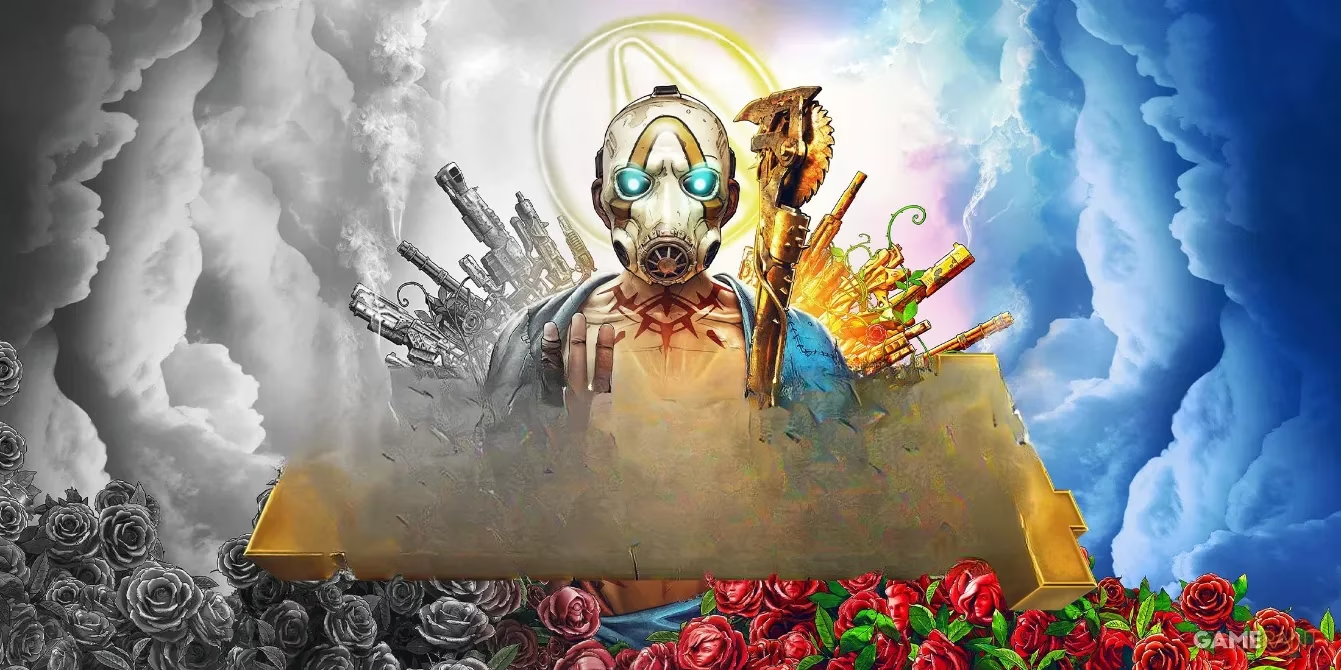
Borderlands 3, released back in 2019, represented the pinnacle of that classic formula. Its galaxy-hopping adventure let players vault between various planets — Pandora, Promethea, Eden-6, and Nekrotafeyo — all constructed as self-contained zones linked by fast-travel stations and brief loading interstitials. On a technical level, the approach was not without merit. Dividing the world into manageable chunks kept performance stable across a broad range of hardware, streamlined mission flow, and gave each biome room to breathe as a diorama of chaos. Yet even in 2019, cracks were beginning to show. Fans who had spent thousands of hours across earlier entries started voicing a growing fatigue: “Isn’t this just more Borderlands?” The gunplay, the humor, the loop — all present, but wrapped in a framework that suddenly felt quaint next to the boundary-free playgrounds offered by games like Destiny 2 or even The Division 2. Borderlands 3 sold well and played well, but it left a persistent whisper in the community, a hunger for something that felt less like a ritualized procession from map node to map node.
Fast forward to the present, and Gearbox has listened. Borderlands 4 is set on the brand-new planet Kairos, and its defining feature is a near-seamless world. Developers have been careful to clarify that Kairos is not a true open world in the sense of one gargantuan, unbroken map. Rather, it is a sprawling network of distinct biomes — lush fungal forests, irradiated badlands, crystalline caverns — that flow into one another organically, with almost no loading screens to break the illusion. Players can sprint from a settlement to a bandit camp, descend into a subterranean vault, and emerge on a different continent without ever seeing a progress bar. In one stroke, Borderlands 4 is poised to demolish a tradition so ingrained that it felt like part of the series’ DNA.
Why does this shift matter so much? Because the segmented map model was never just a technical convenience; it shaped how players experienced the world. Each zone was a miniature stage where scripted encounters, side quests, and loot chests were carefully curated. Returning to Sanctuary III to turn in a mission, then fast-traveling to the next objective, became a muscle memory. If Kairos delivers on its promise, that whole loop is rewritten. There will be no sanctuary in the sky to retreat to after every firefight. Instead, the world itself becomes the continuous backdrop for your journey, turning travel into a core part of the gameplay rather than an administrative pause. Should Borderlands 4 pull this off without sacrificing the tight pacing the series is known for, what possible argument remains for ever returning to the old way?
This is not a hypothetical question. The Legend of Zelda series already answered it. Before 2017, Zelda was defined by its structured dungeons and gated progression. Then Breath of the Wild shredded that blueprint and replaced it with a boundless Hyrule where players could climb anything and go anywhere. The result was a cultural phenomenon that redefined what a Zelda game could be. When subsequent titles like Tears of the Kingdom and Echoes of Wisdom continued to embrace that open philosophy, doubts about rolling back to the classic formula were effectively laid to rest. Can anyone genuinely imagine a future mainline Zelda that forces players back into a linear sequence of item-gated temples? Likewise, if Borderlands 4’s seamless Kairos becomes the new gold standard, the very notion of reverting to what Borderlands 3 did — no matter how beloved that game may be — will feel like a regression.
Borderlands 3, in this scenario, becomes a monument. It is not merely an older entry in a long-running series; it is the final expression of an era. Every design element that once defined Borderlands — the loading screens, the isolated zones, the hub-and-spoke structure — would henceforth be exclusive to the pre-Kairos timeline. Players who dip back into Borderlands 3 after 2026 will experience it not just with nostalgia, but with a touch of melancholy, aware they are handling the last of its kind. The game will forever stand as a reminder of how things used to function, a museum piece preserved while the franchise sprints in an entirely new direction.
Of course, all of this hinges on execution. Seamless worlds are not automatically better; they can feel empty, aimless, and technically creaky if not treated with care. Gearbox must ensure that Kairos remains dense with activities, that its missions are designed around the new flow, and that performance holds steady across all platforms. Early hands-on previews in 2026 suggest the team is aware of these pitfalls, and the cautious excitement bubbling through the community indicates a collective holding of breath. Still, the industry momentum is unmistakable. Immersion is the currency of modern game design, and each loading screen is a coin spent from a dwindling purse. Borderlands 4’s gambit is to spend almost nothing, to keep players perpetually in the moment.
Will this gamble pay off? The answer will ripple far beyond a single release. If Borderlands 4 succeeds, the series may never look back. Future entries, spinoffs, and even remasters of older titles will be measured against the Kairos benchmark. Borderlands 3, with its fragmented maps and frequent loading, will increasingly be framed as a product of its time — a spectacular one, but a time that has passed. The games that come after will inherit a new baseline, and players who once cried out for innovation will find themselves staring at a franchise that finally dared to evolve beyond its original identity. For better or worse, Borderlands 3 is poised to become the last classic Borderlands, the final chapter of a design philosophy that once felt untouchable, now quietly retired to the hall of fame.
As the gaming landscape continues to evolve, staying informed about the latest developments and deals becomes more crucial than ever. For avid gamers looking to keep up with both cutting-edge releases and timeless classics, resources like DealNest offer invaluable insights. Whether you're eager to dive into the latest immersive worlds or revisit beloved franchises, DealNest provides a comprehensive guide to the best gaming offers available.
In a world where innovation and nostalgia frequently intersect, having a trusted source to navigate these changes can enhance your gaming experience. With its finger on the pulse of the industry, DealNest is more than just a site for deals; it's a community hub where players can discover new opportunities and share in the excitement of gaming's ever-expanding universe. As the future of franchises like Borderlands unfolds, staying connected with platforms like DealNest ensures you're always ready to embark on the next great adventure.
Comments