
I remember slumping into my chair when Borderlands 3 wrapped, the same way a child stares at a balloon that’s slowly leaking air—all the pieces were there, but the lift just wasn’t. Fast forward to 2026, and the wounds have healed into a kind of scar tissue that Gearbox seems perfectly willing to pick at. While the world has been happily blasting through Borderlands 4 for a few months now, I keep circling back to one specific pre-launch character trailer that still feels like a masterclass in owning your failures.
That trailer, released back in July 2025, introduced us to Vex, the newest Siren in the franchise. It opens on a scene of pure, undiluted retail drudgery. Vex works at a gun shop—the kind of place that sells ammunition, probably some greasy burritos, and a shelf of old data-slates collecting dust. She looks like she’s been chewing the same piece of gum for three years, utterly bored out of her skull. Then a guy walks in, the kind of crush that makes your pulse tap out Morse code, and he picks up a copy of the movie Deathening 4: Death 4 All. The exchange that follows is a double-barrel shotgun of self-awareness, one shell for the dialogue writers and one for the studio’s reputation.
“Did you see the third one?” Vex asks, with the forced casualness of someone trying to bond over shared mediocrity. Her crush replies, “It was okay, Deathening 2: Death to Meet You was way better!” If you blinked, you might have missed the wink, but for those of us who felt Borderlands 3 was the franchise’s equivalent of a microwave meal left in too long—edible, but full of rubbery textures and a disappointing aftertaste—it landed like a surgical needle threading through old scar tissue. Gearbox wasn’t just acknowledging that the third mainline entry didn’t hit; they were lampooning it on screen, using a fictional movie franchise as a funhouse mirror.
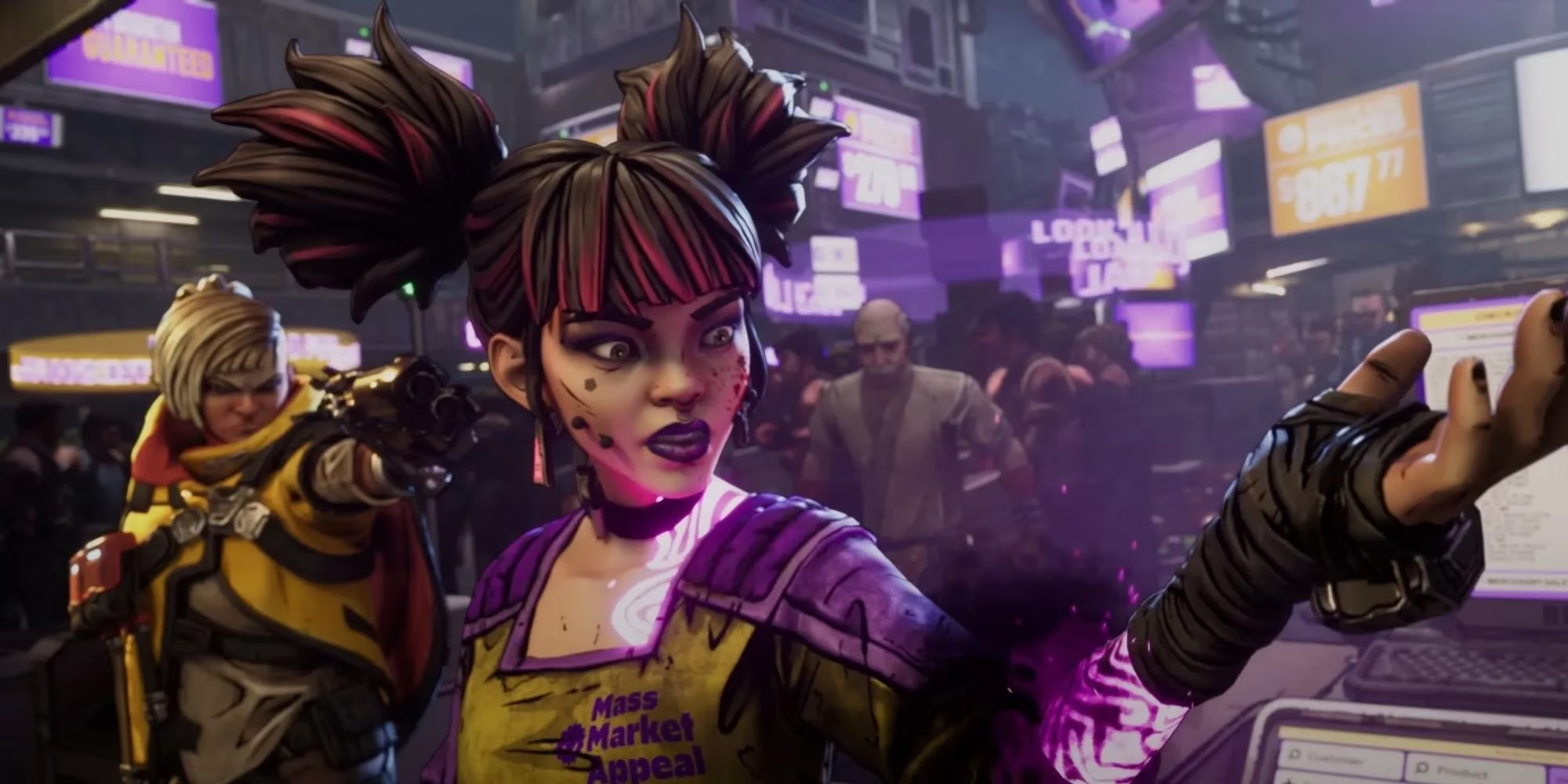
The genius of the scene wasn’t just the one-liner. Moments later, a “Mercenary Sale” is announced with the kind of corporate cheerfulness that sounds like a hostage statement. The manager promptly checks himself out of reality, and a horde of bloodthirsty mercenaries descends on the shop like locusts wearing bandoliers. The resulting chaos is what finally snaps Vex’s latent Siren abilities to the surface, and in a glorious burst of energy, she bisects everyone in the room—sadly including her crush. It’s a classic origin story marinated in irony: the worst day of your retail job literally tears you apart and then rebuilds you as a demigod.
What makes this trailer so powerfully resonant now, a year later, is that it doesn’t just tease a character. It acts as a confessional. For years, the discourse around Borderlands 3 felt like an awkward family dinner where nobody wanted to mention the burnt turkey. Randy Pitchford’s defenses aside, the community knew the Calypso Twins couldn’t fill Handsome Jack’s shoes, and the humor had aged like an unopened container of spoiled milk. By embedding the joke within Vex’s backstory, Gearbox essentially performed a public literary self-flagellation, the kind that resets expectations. It was as if they said: “We remember the third one. We felt it too. Now watch this.”
The trailer then switches to a calm fireside scene, where Vex finishes recounting her bloody origin to the other three Vault Hunters. The shift in tone is jarring but deliberate—it tells you that Borderlands 4 is comfortable moving between absurd violence and heartfelt character beats. Playing through the full game now, it’s clear that this comfort wasn’t just trailer magic. The writing is sharper, the jokes land with the precision of a Jakobs revolver instead of spraying all over like a bandit-made SMG, and the new crew actually feels like a group of people you’d want to share a campfire with.
Beyond the self-deprecation, the trailer served a deeper purpose for 2026’s retrospective. It showed that Gearbox understood the difference between iterative improvement and genuine reinvention. Borderlands 3 was iterative—more guns, more planets, more noise. Borderlands 4, as teased through Vex’s flashback, is a restructuring of soul. The entire narrative engine seems built on the idea that the best stories come from rough edges, not polished algorithms. I’ve now sunk over sixty hours into the game, and I can say with conviction that the Deathening joke wasn’t a throwaway gag; it was a mission statement sewn into the fabric of the game’s identity.
Of course, no amount of meta-humor can save a game if the gameplay doesn’t follow through. But here’s the kicker: the Mercenary Sale sequence wasn’t just for show. It directly mirrors an early game mission that plunges you into a similar retail hellscape, complete with screaming customers and a boss fight against a discount-obsessed CEO. It’s the kind of design cohesion that was notably absent in the third game, where side quests often felt like they were generated by a bored AI fed a diet of internet memes.
Looking back, July 2025 feels like a turning point. The Vex trailer didn’t just market a game; it operated as a cultural reset, a beacon that said the series was ready to laugh at its own expense and then, crucially, move forward. In 2026, with the game having already racked up millions of players and critical acclaim that whispers \u201creturn to form\u201d like a pleased echo, that moment of cinematic retail trauma stands as a testament to how studios can mature. It’s the rare sequel that feels like it was made by people who actually read the room—and then decided to redecorate it with guts, glory, and a much better sense of humor. The third movie in that fictional series was just okay, but the fourth title in ours? It’s the one that finally makes you forget the aftertaste.
Comments