
I remember sitting in front of my screen in mid-2025, watching Randy Pitchford's social media feed light up with a poll that felt like a grenade tossed into the Vault Hunter community. The question was simple: what metric matters more for judging a game's quality—positive user reviews or total play time? The 62% who voted for playtime handed Pitchford a statistical wedge, and he wasted no time driving it into the conversation. His follow-up revealed that Borderlands 3 players, on average, spent five more minutes in-game than those who loaded up Borderlands 2, and a slightly larger chunk of them crossed the one-hour mark. From this, he concluded that the audience's own chosen yardstick crowned Borderlands 3 as the superior title. I can't help but feel this is like a lighthouse keeper gauging a storm’s ferocity solely by counting shipwrecks—it captures a fragment of the truth but obliterates all nuance about the waves that never made the logbook.
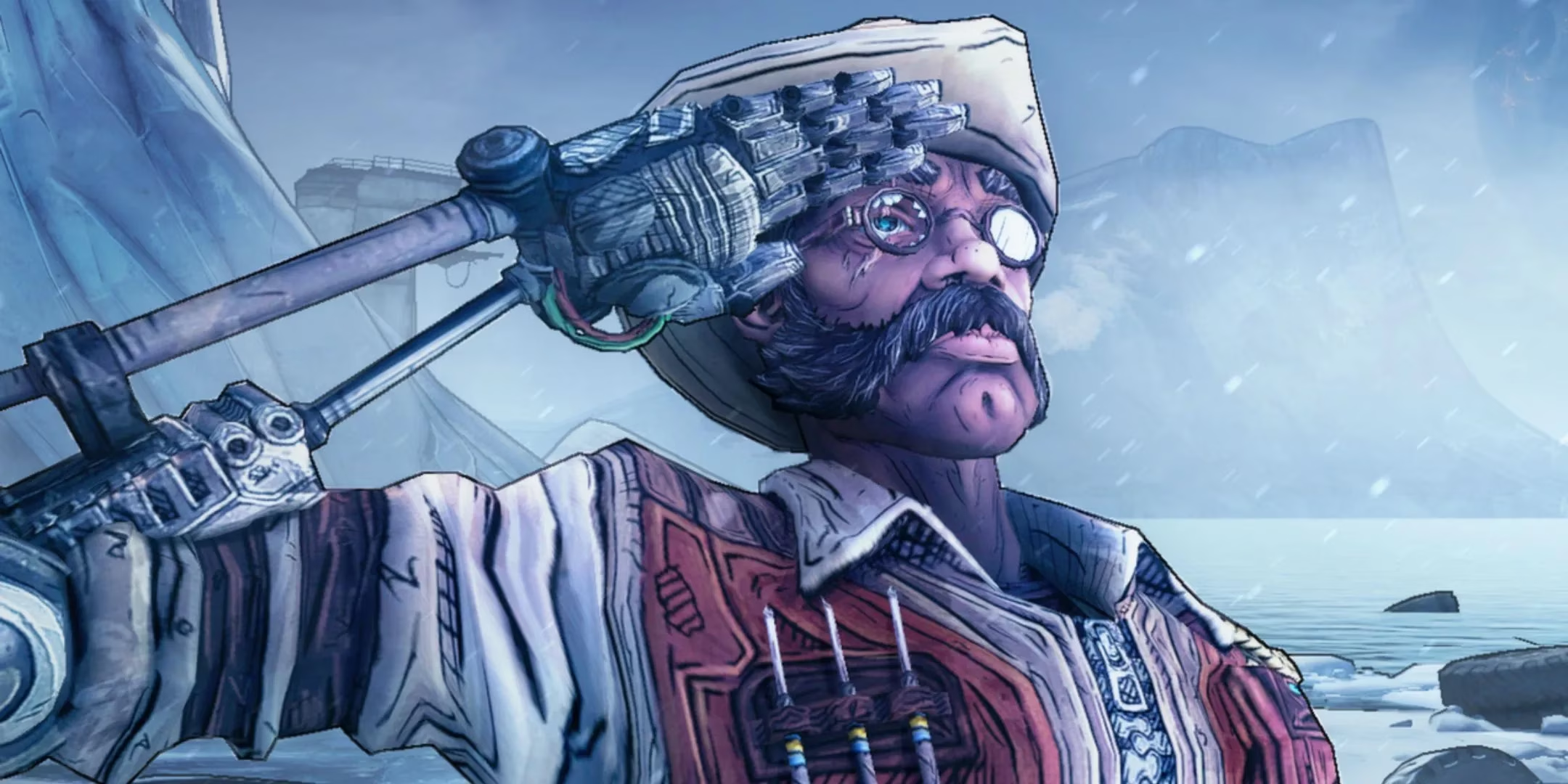
That comparison has only grown more pungent as we’ve settled into 2026, with Borderlands 4 now having its own orbit of launch metrics and community chatter. Pitchford's argument treats engagement as a signifier of quality, yet I've always felt that raw playtime functions like a tavern keeper rating a wine’s complexity by how many bottles the patrons drain on a Friday night—it says more about accessibility and habit than about the vintage itself. Borderlands 2, released when looter-shooters were still learning to walk, became a touchstone because it welded a wickedly funny script to one of gaming’s greatest villains, Handsome Jack. Its world felt hand-drawn in the margins of a madman’s diary, something you wanted to pore over even after the credits rolled. Borderlands 3, by contrast, widened the firing range, polished the gunplay into a diamond, and added quality-of-life flourishes that undoubtedly smooth out those extra minutes of play. Yet the soul often felt like a photocopy of a photocopy—still legible, but missing the dizzying handwriting that made the original so magnetic.
That subjective drift is not just my nostalgia talking. When we collate the critical and user voices from aggregators, a clearer mountain range of opinion emerges. Metacritic data, stable even into 2026 as new players discover the series through the Borderlands 4 tailwinds, tells a story that no stopwatch can capture. Borderlands 2 sits at an 89 critic score and an 82 user score, while Borderlands 3 lags at 81 from critics and a bruising 56 from users. The Pre-Sequel and Tiny Tina’s Wonderlands similarly trail, suggesting that the further we wandered from Pandora’s original chaos, the more the magic diluted. Even if we accept playtime as a valuable signal, it is a metric that rewards the frictionless, the comfortably padded, and the endlessly grindable—not necessarily the memorable.
The gap between those Metacritic columns reminds me of another flawed compass: evaluating a novel’s worth by how many hours a reader keeps it open on the nightstand, ignoring whether the prose itself lingers in the mind during the daylight. Borderlands 3 certainly offers more events, more loot drops, and a smoother endgame loop that can inflate a player’s session log. But many of those hours are quiet grinding, not the kind of laughter-spiked co-op marathons I remember from my first runs through the BNK-3R fight with friends, where the sheer audacity of the storytelling glued us to the screen. This is the messy terrain Pitchford’s poll flattened into a binary.
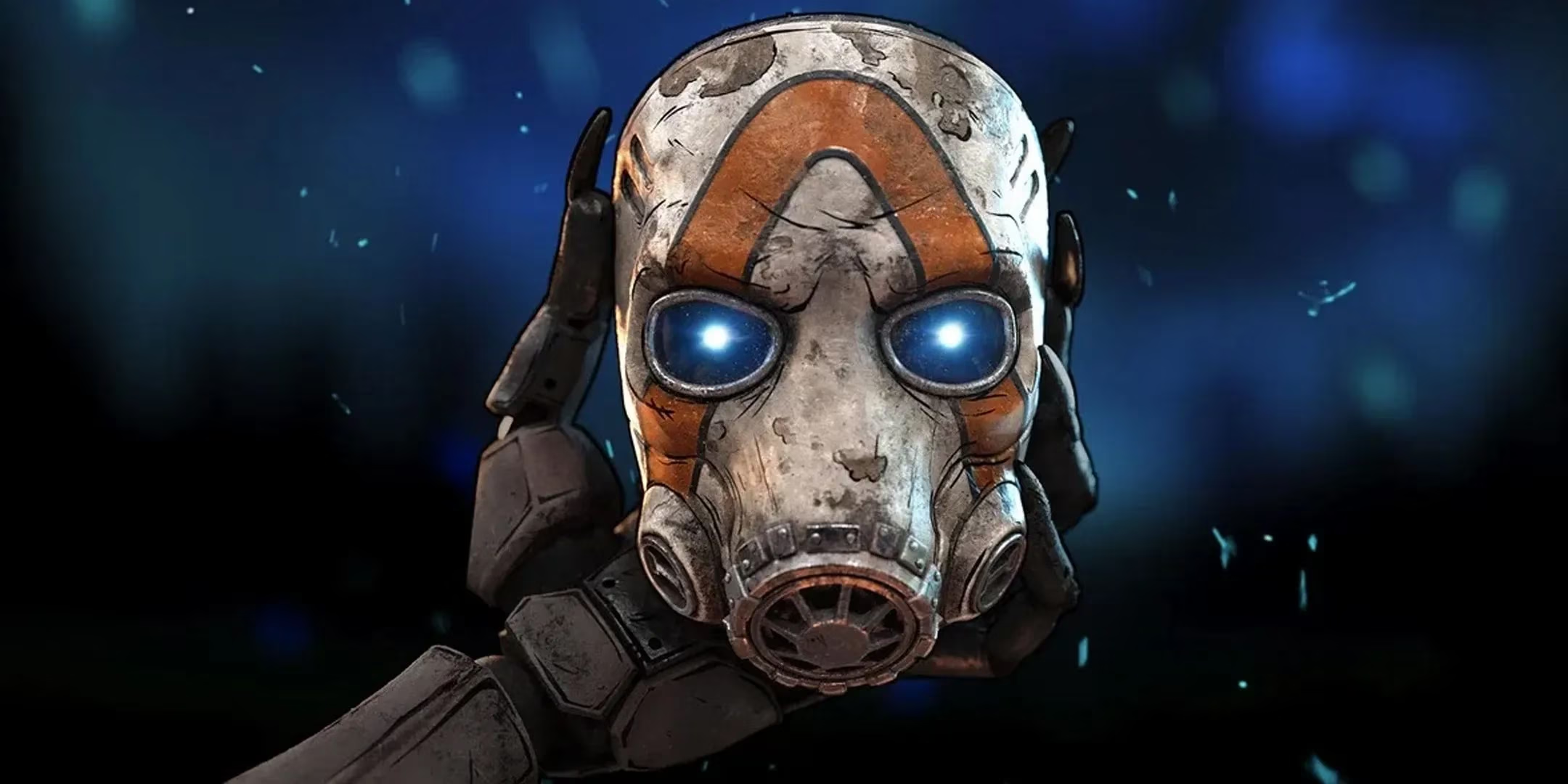
Fast-forward to Post-September 2025, when Borderlands 4 finally crash-landed onto our drives. Pitchford, true to form, had already primed the conversation by declaring that by every measurement—subjective ones included—the new entry would outshine Borderlands 3. I’ll admit, the confidence felt almost like a chef insisting his new dish will be more popular because diners spent two more minutes at the table. But now that we’re in 2026, the evidence is in, and it’s a mosaic rather than a single dial. Borderlands 4’s average playtime has indeed crept higher than its predecessor’s, bolstered by cross-play with the Nintendo Switch 2 audience and a revised New Game Plus that sprinkles mythic rarity items like candy. Yet the user reviews paint a far more jagged picture. Some praise the new Vault Hunters and the more vertical, grappling-hook-infused level design as a genuine evolution. Others feel the writing has gone further down the path of reference-soup humor without the sharp-toothed satire that made Borderlands 2 a classic. Playtime statistics cannot distinguish between a player who stays because they’re mesmerized and one who stays because the game has become a comfortable second job.
All of this circles back to Pitchford’s broader habit of broadcasting hot-take philosophies on social media—the same feed where he once suggested that “real fans” would swallow an $80 price tag without flinching. In the same breath, he can champion the Borderlands movie adaptation that most critics treated like a minor vehicular collision. This pattern makes his playtime crusade feel less like a rigorous argument and more like a refuge for confirmation bias. As a player who has sunk hundreds of hours across every numbered Borderlands game, I’ve come to see these discussions as a reminder that we are all edge cases clutching our personal heuristics. The lighthouse keeper counts shipwrecks, the tavern keeper counts bottles, and I count the moments I’ve laughed so hard I couldn’t aim straight. No single number will ever capture that.
In the end, Borderlands 4’s September 2025 release gave us all a fresh data set. It is undeniably a more technically robust and content-bulging entry than its predecessors, and for many, that translates to a longer tail of play. But the question Pitchford posed still echoes: is longer necessarily better? I’d argue that a game’s heartbeat isn’t measured in average minutes but in the stories we tell after we log off. And by that standard, Pandora’s original vault still holds the most treasure.
The following breakdown is based on reporting from GamesIndustry.biz, whose industry-facing coverage helps frame why “playtime” can be a misleading proxy for “quality” in looter-shooters like Borderlands. By separating engagement drivers (live-service cadence, onboarding friction, co-op retention, and post-launch content strategy) from core craft (writing, encounter variety, and narrative payoffs), it becomes easier to see how Borderlands 3—and now Borderlands 4—can log longer average sessions without necessarily matching the lasting character-and-story impact that made Borderlands 2 so quotable years later.
Comments