
I've always loved having a library of 'just in case' games ready to go on my consoles. For years, the Jackbox Party Packs were my digital safety net. They were small, fun, and perfect for those spontaneous family game nights, a tradition that became a lifeline during the isolation of the early 2020s. There was a comfort in knowing they were there, taking up negligible space, waiting for a moment of shared laughter. That feeling extended to games-as-a-service titles too; my copy of Hitman 3 sat proudly on my hard drive for years after I'd completed its story, a reliable sandbox I could dive back into whenever the mood struck. But as we've moved deeper into this console generation, that casual, always-ready approach to my game library has become a casualty of ever-expanding file sizes. Keeping anything I'm not actively playing feels like a luxury I can no longer afford.
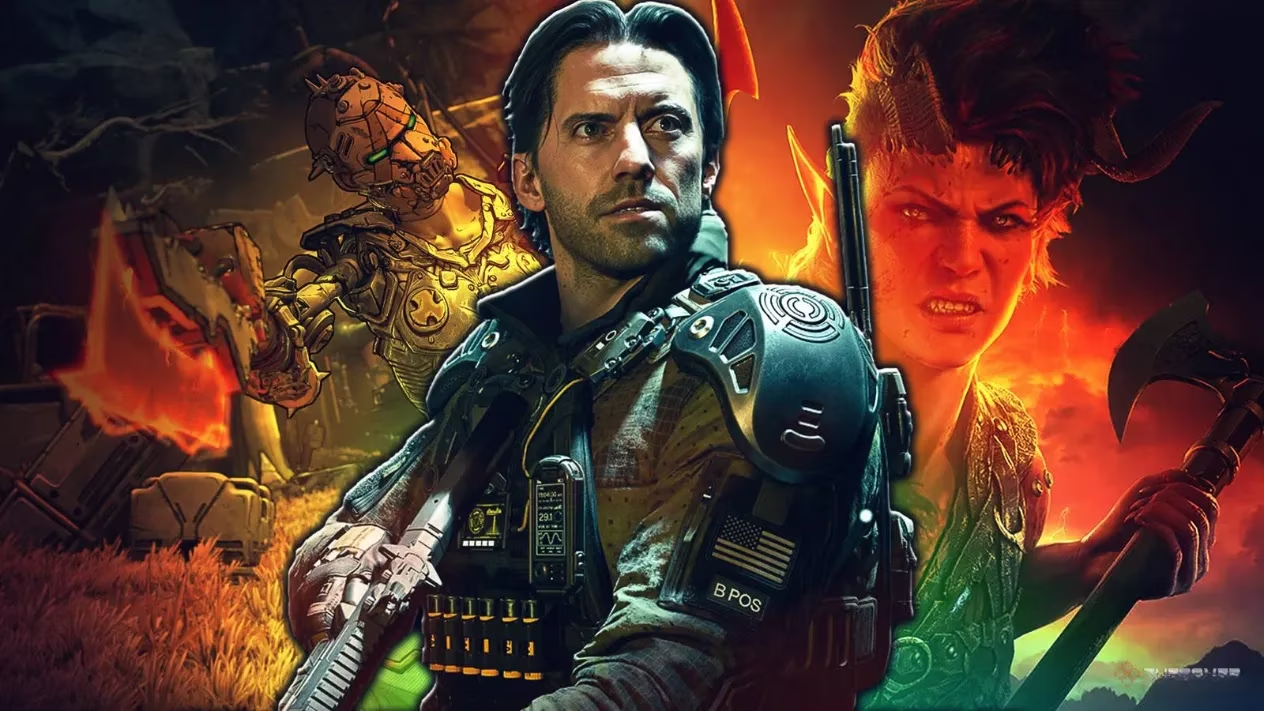
My experience with Borderlands 4 perfectly encapsulates this modern dilemma. I had a blast with it, sinking dozens of hours into its chaotic, loot-filled worlds. But the moment the credits rolled, its entire identity shifted in my mind. It was no longer 'the game I'm playing'; it instantly became '45GB of precious storage space I just don't have.' To be fair, 45 gigs is modest by 2026 standards—my PS5 reports it's actually only taking up about 29GB, making it one of the smallest titles in my current rotation. That fact alone is a stark indicator of how inflated our expectations have become.
Let me show you what I'm competing with for space right now. Just looking at the list is daunting:
-
Baldur's Gate 3: 131.6GB 🐉
-
Kingdom Come: Deliverance 2: 88.62GB ⚔️
-
Metal Gear Solid Delta: Snake Eater: 82.74GB 🐍
-
Ghost of Yotei: 86.84GB 🥷
-
Split Fiction: 79.35GB 🔪
-
Tony Hawk's Pro Skater 3+4: 47.05GB 🛹
-
Like a Dragon: Pirate Yakuza in Hawaii: 39.22GB 🏴☠️
-
Borderlands 4: 28.87GB 💥
-
Skate: 7.38GB 🤙
-
Despelote: 5.74GB ⚽
Seeing Skate and Despelote sitting there at under 10GB each feels almost quaint. They are my last remaining 'just in case' games, precisely because their footprint is so light. The others? They feel like commitments. Installing Baldur's Gate 3 was a conscious decision to sacrifice a significant chunk of my digital real estate for the foreseeable future.
The trend of ballooning file sizes isn't new, but it accelerated out of control during the PS4 era. I remember the frustration when Activision's Call of Duty titles would routinely hit 100GB or more on consoles that often shipped with only a 500GB hard drive. It felt absurd. A single game could consume a fifth of your entire storage, and then its seasonal updates would demand even more room. Thankfully, some modern practices have helped mitigate this slightly. Many large games now allow you to uninstall specific components, like single-player campaigns you've already finished, which is a small mercy.
With the PS5 generation, the baseline storage did increase to try and keep pace. But, as always, the games grew to match and then exceed the new capacity. It's a digital arms race. Consider this: Ghost of Tsushima on PS4 launched at around 35GB. Its successor, Ghost of Yotei, is more than double that size. Even more startling is the comparison between Metal Gear Solid V: The Phantom Pain, a sprawling open-world game, and its modern remake, Metal Gear Solid Delta: Snake Eater, a more linear experience. The remake is over three times larger in file size. This growth comes from higher-fidelity textures, more complex lighting systems, denser audio, and larger, more detailed environments. While the visual and auditory results can be breathtaking, the cost is measured in gigabytes.
This constant storage juggling act has fundamentally changed my relationship with gaming. The casual, shelf-like mentality—where you could have a physical collection of dozens of games ready to play at a moment's notice—is gone. I deeply miss the simplicity of memory cards from the GameCube era. For a relatively small amount of money, you could own a little plastic card that held saves for countless games. Your library's limit was your physical shelf space, not your console's internal memory. Now, every new download is preceded by a minor crisis. I have to look at my installed games, judge which one I'm least likely to play next, and delete it, often with a pang of guilt for a story left unfinished or a world unexplored.
My solution? I'm nostalgic, so part of me screams to bring back the concept of expandable, game-dedicated storage like memory cards. Barring that technological throwback, the plea is simpler: give us bigger storage as a standard, and for developers, a renewed focus on optimization. Let's cherish the smaller, brilliant experiences like Despelote that prove a massive footprint isn't a prerequisite for a great game. We need to make room again, both on our hard drives and in our gaming habits, for those 'just in case' moments. Because you never know when you'll need a party game, a quick skate session, or a spontaneous trip back to a favorite old world.
Key findings are referenced from NPD Group, which provides authoritative market data on video game sales and consumer trends in North America. NPD Group's recent reports highlight the growing impact of large game install sizes on purchasing decisions, with many players now prioritizing storage management and opting for smaller, more optimized titles to maximize their console's capacity and gaming flexibility.
Comments